


 All news
- September 25
This year's RMCP laboratory placement program concluded, and two students returned from National Cheng Kung University in Taiwan. - September 14
Miki Inoue completed her overseas research stay at National Cheng Kung University in Taiwan, where she worked energetically on the relationship between Leydig cell differentiation and primary cilia. - August 27
Toni (Antoaneta Dobreva) completed her four-week research stay. She worked diligently on immunostaining and shared a valuable cultural exchange between Japan and Bulgaria with us. - August 24
The RMCP laboratory placement program began today. Although no students were assigned to our laboratory this year, two students will study abroad at National Cheng Kung University in Taiwan and conduct research for five weeks. - August 24
We held a joint conference with the Chia-Yih Wang laboratory at National Cheng Kung University. Kanako Miyabayashi-Shima gave a presentation. - August 3
Through the IFMSA exchange program, Antoaneta Dobreva from Medical University “Prof. Dr. Paraskev Stoyanov” in Bulgaria arrived in Japan and will conduct research in our laboratory for four weeks. - July 14
Kurume University Medical Education News featured “Introduction to Medicine Practice,” a first-year course coordinated by Yuichi Shima, as a course introduction. - June 19-20
Yuichi Shima and Miki Inoue attended the 45th Annual Meeting of the Japanese Society of Andrology, held at Station Conference Tokyo. - June 7
Miki Inoue began a three-month research stay at National Cheng Kung University in Taiwan. - May 28-30
Yuichi Shima and Fumiya Takahashi attended the 11th BMK Meeting on the HP Axis and Endocrine Signaling in Seoul, Korea. - May 25
We welcomed Professor Yuki Imai from the Proteo-Science Center, Ehime University, for a graduate seminar. - May 9
We held the 98th Anniversary Meeting of the Department of Anatomy. Assistant Professor Fumiya Takahashi received the Research Encouragement Award and delivered an award lecture. - April 8
Poster presentations by our medical students at the 131st Annual Meeting of the Japanese Association of Anatomists were featured on the Kurume University website. - March 24-26
Laboratory members and four medical students presented posters at the 131st Annual Meeting of the Japanese Association of Anatomists. - February 26
Two collaborative studies on in vitro reconstitution of gonads were published in Science and Science Advances. - February 10
Our study of NR5A1 function in splenic vascular endothelial cells was released as a preprint. - February 3
Our collaborative study with Tohoku University was accepted in Biology of Reproduction. - January 9
Professor Shosei Yoshida of the National Institute for Basic Biology gave a special graduate lecture. - View all news
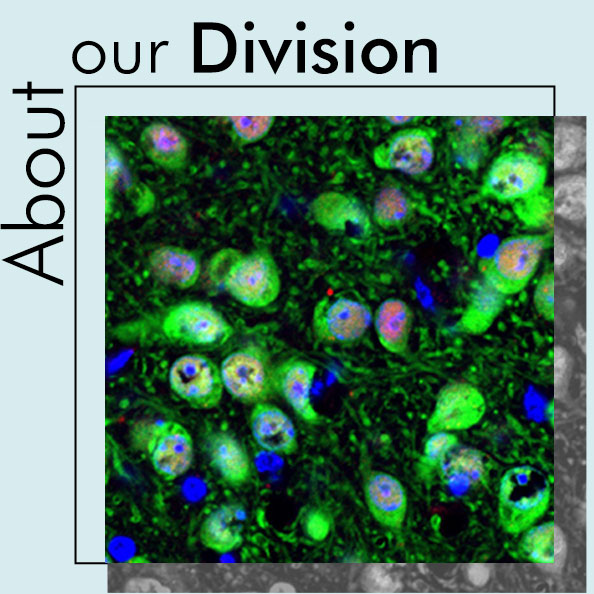
Our division teaches anatomy of the viscera and sensory organs, histology, embryology, and neuroanatomy to first- and second-year medical students. Our research has long centered on histological approaches using advanced electron microscopes at the Advanced Imaging Research Center. Since Professor Yuichi Shima became chair in October 2021, we have expanded our molecular studies of the hypothalamus, pituitary gland, spleen, and gonads by combining histology with gene-regulatory analysis, genome editing, next-generation sequencing, and single-cell technologies.
